• Post-mortem examination was performed in 798 piglets from 363 litters.
• The major post-mortem findings were starvation (34%) and crushing (28%).
• Fewer piglets starved to death in STRAW compared to CONTROL-litters.
• Strategic use of straw reduced the number of stillborn piglets by 27%.
Abstract
Piglet survival is the outcome of complex interactions between the sow, the piglet and
their environment. In order to facilitate nest-building and to provide a suitable environment for the newborn piglets, a strategic method to supply loose housed sows with large quantities of straw at farrowing has been developed by Swedish piglet-producing farmers. The objectives of this cohort study were to use post-mortem findings to assess the causes of death and to quantify the effect of a large quantity of straw provided before farrowing compared to limited small daily amounts on stillbirths, post-mortem findings in piglets dying within 5 days after birth and the pre-weaning mortality. On each of four commercial piglet-producing farms in South-West Sweden, one batch of sows was studied during two consecutive lactations. At inclusion, sows were randomly assigned to two treatment groups, and sows remaining in the batch during the next lactation switched treatment group. In the STRAW group (n = 181 litters) sows were provided with 15–20 kg of chopped straw 2 days prior to the calculated date of farrowing. Sows in the CONTROL group (n = 182 litters) received 0.5–1 kg of chopped straw on a daily basis plus about 2 kg for nest-building when the stockperson judged the sow to be about to farrow. After onset of farrowing, additionally 1–2 kg was given. Post-mortem examination was performed in all piglets that died within 5 days after birth (n = 798). The three major post-mortem findings were starvation (34%) crushing by the sow (28%), and enteritis (24%). In conclusion, strategic use of large quantities of straw reduced the number of stillborn piglets per litter by 27% (p = 0.007). Under the conditions studied, the pre-weaning mortality of liveborn piglets was not affected by treatment; however, the distribution of post-mortem findings differed with fewer piglets dying due to starvation and more due to crushing and enteritis in STRAW litters.
Tail biting behaviour is a major animal welfare issue in intense pig production, as well as an economic issue. To prevent the behaviour, tail docking is practised. It is a painful procedure where a part of or the whole tail is cut off.
There is a lot of research on the subject of tail biting, with a big variety of solutions to prevent the behaviour. Scientists are consistent about that the absence of manipulable material increases the risk for tail biting. Manipulable material works as an environmental enrichment and stimulates natural behaviours of the pig, such as investigation and rooting. It helps pigs to cope with the environment and reduces stress and frustration, triggers that can lead to tail biting.
The legal requirement regarding tail docking state that it shall not be practised on a routine basis and has been in force since the 1st of January 1994. It was strengthened in 2003 and now appears in Council Directive 2008/120/EC which codifies the earlier directives. The legal requirement now states that measures to prevent tail biting shall be taken before practising tail docking, measures such as changing inadequate management systems, changed environment and reduced stock densities.
Pigs shall also have access to a suitable material or object, to be able to perform natural behaviours and prevent tail biting and stereotypies. In the latest version of the directive on pigs this material was defined as straw, hay, wood, sawdust, mushroom compost, peat or a mixture of such.
The aim of this study was to investigate the current situation of compliance with the legal requirements in the directive on pigs, regarding the provision of manipulable material and the routine practice of tail docking. It was also to investigate actions to increase compliance among the Member States in the European Union. A descriptive analysis of available FVO-reports was used, together with written answers from the Competent Authorities and a qualitative interview with people at the Commission and the FVO.
The results of this report showed that 18 out of 28 Member States in the European Union do not comply with the legal requirement regarding the provision of manipulable material, and that 17 of the Member States do not comply with the legal requirement regarding the practice of tail docking. There has not been any actions such as sanctions to increase the compliance among the Member States.
These findings make an overall conclusion possible about the current issues with the compliance of the directive on pigs. There are no further intrinsic actions to increase compliance, due to a lack of responsibility among the involved parties, such as pig farmers, Competent Authorities and the Commision. Due to the lack of intrinsic action, it is an impossibility to conclude when full compliance will be fulfilled.
We found e.g. that pieces of recently harvested young birch trees, suspended horizontally below snout level and with a length of 30 cm of tree stem per pig, reduced mild tail and ear biting and increased object exploration, but did not reduce severe tail biting, i.e. biting part of the tail off. Another finding was that a polythene pipe cross, suspended horizontally at snout level, also increased object exploration (as compared to controls with a simple metal chain) but did not reduce tail and ear biting, supporting earlier findings that the frequency of object exploration is not a sufficient predictor of the capacity of that object to reduce tail biting.
Providing straw is a well-known obstacle for use on slatted floors because as the straw may rapidly get out of reach of the pigs by falling through the slats and because the straw may block the liquid manure handling system. Research in Sweden investigates the throughput capacity of straw for nestbuilding in farrowing sows and for reducing tail biting in weaned and growing-fattening pigs.
Nest-building behaviour is regarded as a behavioural need for the pre-partum sow and sows in modern pig husbandry are highly motivated to perform this behaviour. A sow that lacks possibilities to perform foraging and nest-building behaviour at farrowing will be frustrated and stressed, which can result in reduced piglet survival or savaging of piglets. Thus, sows should be provided with appropriate substrate to perform nest-building behaviour at farrowing.
Furthermore, many newborn piglets in modern pig production develop lameness and poor claw health due to poor floor quality. Lame piglets often need medical treatment and have a reduced growth rate. The claws of newborn piglets have an extremely soft horn tissue making them vulnerable to bruising in early life. However, a few days after birth, the horn tissue becomes harder and more resistant to injury. Provision of straw as bedding only during the first week of life might therefore be sufficient to reduce the incidence of lesions. Straw bedding is also a source of thermal insulation, found to be suitable for the prevention of prolonged hypothermia in newborn pigs. Piglets with a low body temperature are more likely to die from infections or crushing. Provision of straw to newborn piglets may increase their welfare by decreasing the risk of lameness and/or hypothermia.
In a Swedish study a strategic usage of straw was investigate in two commercial piglet producing farms. The ability of straw to drain through slatted flooring was studied giving the sows 15 kg of chopped straw around the time of farrowing. In total 96 sows were studied and all sows were loose housed in partly slatted farrowing pens (plastic or cast-iron slats). Chopped wheat straw of three different lengths was compared. The mass median straw lengths were 39, 70 and 130 mm, respectively. It was found that by Day 4 after farrowing straw with short and medium chop length was completely absent in 83% (plastic slats) and 85% (cast-iron slats) of the pens. However, at Day 4 straw was absent in only 6-7% of the pens provided with the longest straw category.
The conclusion from the study is that it is technically feasible to maintain good pen hygiene in partly slatted farrowing pens, even if the sows are provided with 15 kg of chopped straw at farrowing. However, straw chop lengths need to be adjusted to the type of slatted flooring used.
Farrowing sow in straw nest (Photo by Rebecka Westin)
When these results are applied to the objective of using straw as enrichment for growing pigs and to counteract tail biting, the paper shows that it is possible to use straw cleverly and adapt the straw structure to the slatted floor. Optimal is that we give the pigs straw of a structure that enhances their litter related behaviours, but at the same time remains manageable for the farmer and the manure system. This study shows that chopped wheat straw of mass median lengths between 39 and 70 mm can be managed in a slatted system. The paper also evokes the thought that the amount of straw could be varied according to the behavioral needs of the growing pigs, e.g. more straw could be provided to the pigs when they are put into to a new compartment after weaning. Ideally, it could also be possible to develop a monitoring system of early warning of impending tail-biting outbreaks and then increase the amount of straw given to the pigs to counteract (and hence prevent) the outbreak. This could be partly automatic (precision livestock farming).
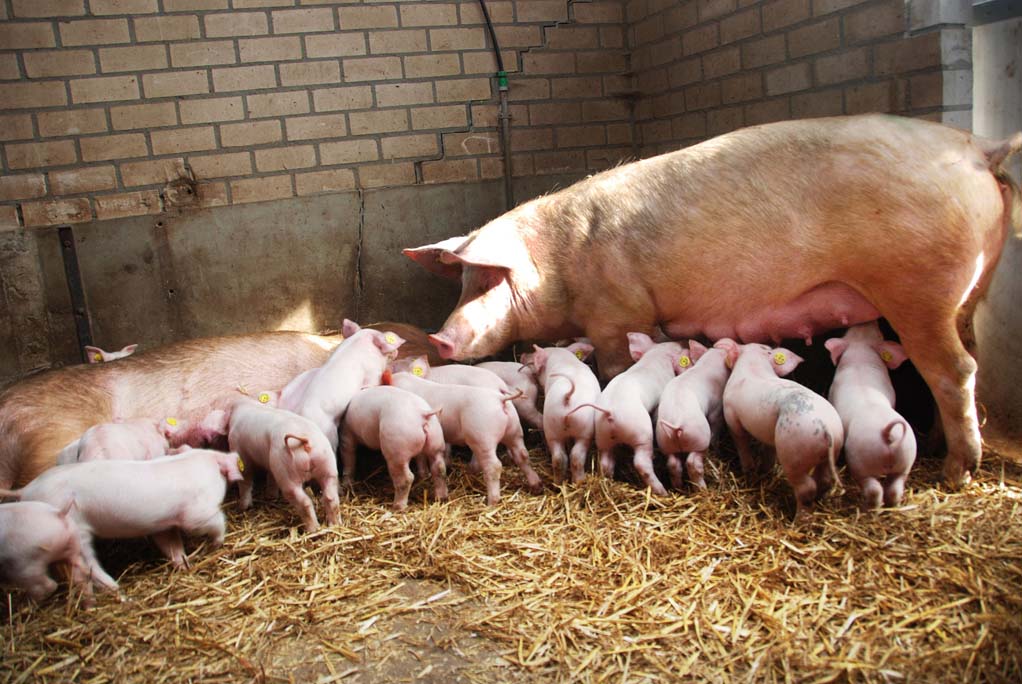
Farrowing sow and piglets on straw (Photo of Rebecka Westin)
Some further questions
* To what extent was the straw remaining available to the pigs, e.g. what % is lost through the slats and for how long is it visible in the pen?
The straw (15 kg) was given 2 days prior to expected farrowing and the remains were scored 6 days later (i.e. four days after farrowing). Plastic slats dimensions were: slat width 15 mm, opening width 10 mm, opening length 36 and 84 mm. Cast iron slats: slat width 11mm, opening width 11 mm and opening length 200 mm.
In plastic-slatted pens (i.e. on Farm A), bedding was completely absent (0 kg) on Day 4 in 25 of 30 pens (83%) when provided with straw of short or medium chop lengths compared to 1 of 15 pens (7%) provided with long straw. Similar figures were seen on Farm B which had cast-iron slatted pens, where bedding was absent in 22 of 26 short/medium straw pens (85%) and 1 of 17 long straw pens (6%), respectively. On Day 4 after farrowing, 37 of 43 cast-iron pens (86%) were completely dry and clean on the solid floor. This was the same for the plastic-slatted pens provided with bedding of short or medium straw. However, in plastic-slatted pens provided with bedding of long straw, hygiene became worse over time.
* To what extent did the manure system get blocked, both in the short term and long term?
It was never blocked as the sow and the piglets were degrading the straw over time. In this case 15 kg was given once to the sows for the 6 days. After that, from Day 4 after farrowing and onwards, a small amount of chopped straw (~0.5 kg) was given daily according to the farms’ regular management practice. Weaning was performed after 5 weeks. For the total suckling period it was ~35 kg of straw used.
* What remains to be done in the FareWellDock project?
We will investigate the straw amount and the length that could be used to find an optimum level for usage in semi-slatted pens for growing-fattening pigs. The optimum is where enough straw is provided to minimise the risk of tail and ear biting, while pen hygiene and manure system continue to function at acceptable levels to the farmer. We will start with a survey in Sweden to investigate this further.
Highlights
•Strategic use of large quantities of straw effectively prevents piglets from developing skin abrasions and claw lesions.
•The overall prevalence of skin and claw lesions was reduced by at least 50% in STRAW compared to CONTROL piglets.
•Average daily weight gain until 5 days of age increased by 25 g in the STRAW treatment.
•Mean body weight at weaning increased by 0.33 kg
This post illustrates the so-called branched chain design. This is an improved type of chain that seems most suited as a starting point towards providing proper enrichment (as required by e.g. EU legislation) for conventional, intensively-farmed pigs. However, also pigs on straw may benefit from such chains. Below the description of the branched chain design you can find some pictures and video clips of branched, anchor-type chains for pigs (conventionally-housed weaners and growing fattening pigs, and gilts kept on straw).
Specification of the branched chain design
1: Object-design: A branched chain consists of a vertically-positioned long chain with its end resting on the solid floor over a distance of 20 cm. Two or three additional chain ends (branches) end at or slightly below the nose height of the smallest and middle-sized pigs reared in the pen.
2: Material: The chains are stainless-steel anchor chains (for at least the last 5-10 links of each chain end). Recommended dimensions are 7mm for growing-fattening pigs, 5-6 mm for weaners, 4-5 mm for piglets and 8 mm for sows.
Anchor chains have links which are more round and heavier than the cheaper, more oval-shaped c-chains. Note that the indicated sizes refer to the diameter of the metal, not the diameter of the links. For example, a 7 mm anchor chain for finishers has links measuring 36×23 mm. Preferably various chain sizes should be provided in the pen, esp. when the pen may contain pigs of variable sizes (e.g. from 25 to >100 kg). Stainless-steel anchor chains are more expensive, but only the last 5 or so links need to be replaced when worn e.g. every 5 – 10 years.
3: Availability and placement: One branched chain is provided for every 5 pigs.The chains are spaced apart as much as possible, preferably with at least one pig length between 2 branched chains in a pig pen. The branched chains are attached at the top end of the pen wall, over the solid floor, and not in the dunging area.
Short chain and ball. Note the bite marks on the ball. The ball is hanging on a c-chain (oval shaped). The short chain resembles an anchor chain but isn’t (links not massive enough).
Short chain, ball and branched chain made of suboptimal c-chain links. This type of branched chain uses only 1 fixation point (reducing costs).
Branched anchor-type chain with 3 branches. Only top left branch is made of c-chain in order to ‘test’ pig preferences for the anchor-type chains (top right branch).
Four stainless-steel anchor chains. Two middle chains are worn by long-term use (5-10 years). Outer chains show original shape.
Branched chain provided to weaned piglets
Occasionally a pig will be reaching up. But normally they show downward-directed behaviour.
Branched chain for fatteners
Most manipulation of the branched chains is floor directed. Both rooting and biting/chewing/playing.
Floor directed ‘rooting’.
The pig’s nose really ‘fits’ a floor-directed orientation.
Also some more horizontal chewing
Sometimes more pigs are interested in the same thing.
Side-way chewing (fits into cheek fold for canine teeth).
Taking a whole branch (10 links) into the mouth.
Three pigs all at once.
Some occasional pulling.
Empty straw-bricket container. The floor plate may be used to keep a chain from getting stuck in the slats and/or repair when the floor below the branched chain gets worn.
Gilt in a straw pen next to a branched chain between the lying area (front) and dunging area in the back of the pen.
Floor-directed chain manipulation may be labelled ‘rooting’ …
…not just because there is also some straw…
…it resembles stone chewing seen in outdoor sows.
A second branched chain in the same pen containing four gilts.
Grabbing the chain horizontally, showing the cheek fold.
A branched chain in another pen containing two gilts on straw.
Floor directed behaviour
Biting the chain occasionally.
Fixation of the floor chain using the right front leg. True ‘manipulation’ (as manus in Latin means ‘hand’).
Branched chain worn temporarily as an ‘ear ornament’.
Two gilts playing with the branched chain at the same time.
Anchor-chain links worn (right) by pig manipulation.
These pictures may be used for non-commercial purposes & publications provided copy-rights (MB) are acknowledged.
The video clips below show the pigs in action.
This video shows that a hockey-type ball may be frustrating for pigs, and that the branched chain design is much more appreciated, even by organic pigs.