Tag Archives: Tail lesions

Can tail damage outbreaks in the pig be predicted by behavioural change?

Vestbjerg Larsen, M.L., Andersen, H.M-L, Pedersen, L.J. 2016. Can tail damage outbreaks in the pig be predicted by behavioural change? The Veterinary Journal 209: 50-56.

Abstract

Tail biting, resulting in outbreaks of tail damage in pigs, is a multifactorial welfare and economic problem which is usually partly prevented through tail docking. According to European Union legislation, tail docking is not allowed on a routine basis; thus there is a need for alternative preventive methods. One strategy is the surveillance of the pigs’ behaviour for known preceding indicators of tail damage, which makes it possible to predict a tail damage outbreak and prevent it in proper time. This review discusses the existing literature on behavioural changes observed prior to a tail damage outbreak. Behaviours found to change prior to an outbreak include increased activity level, increased performance of enrichment object manipulation, and a changed proportion of tail posture with more tails between the legs. Monitoring these types of behaviours is also discussed for the purpose of developing an automatic warning system for tail damage outbreaks, with activity level showing promising results for being monitored automatically. Encouraging results have been found so far for the development of an automatic warning system; however, there is a need for further investigation and development, starting with the description of the temporal development of the predictive behaviour in relation to tail damage outbreaks.

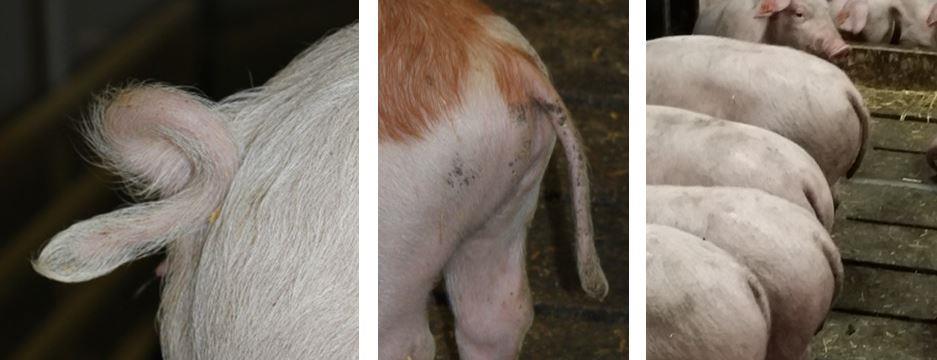
Tail postures
Tail postures
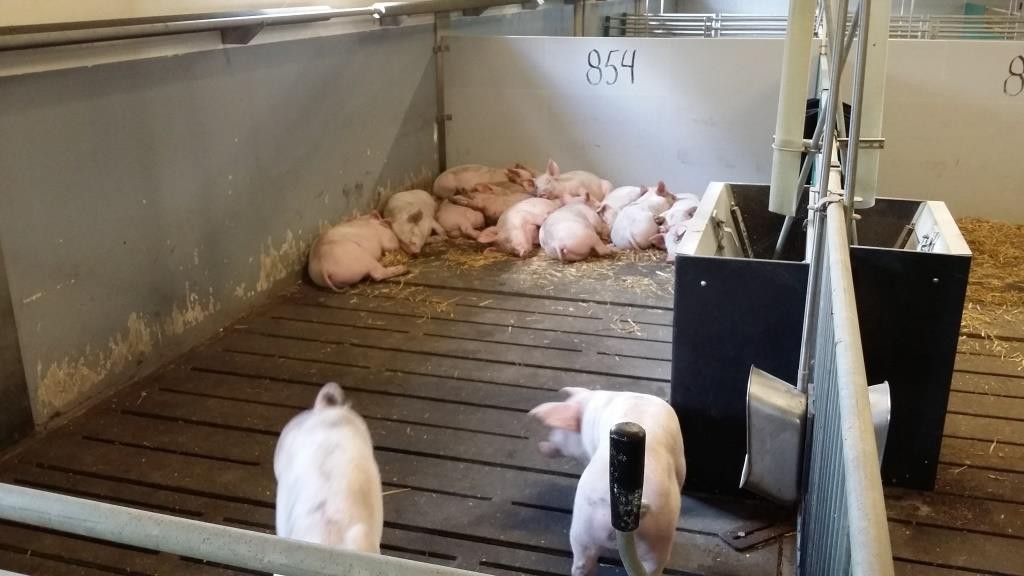
Pigs resting on straw

See also the related editorial:

Zonderland, J.J. and Zonderland, M.A., 2016. Behavioural change by pig producers is the key factor in raising pigs with intact tails (Editorial). The Veterinary Journal.

Histological and neurophysiological pain assessment in young pigs

Original title: Approche histologique et neurophysiologie de la douleur liée à la coupe de queue chez les porcelets

Presentation of Dr. Dale Sandercock (SRUC) at a seminar on histological and neurophysiological approaches to pain assessment in young pigs. INRA-PEGASE, St-Gilles, France, December 14th 2015

Abstract

Concerns exist over the long term consequences of tail docking on possible tail stump pain sensitivity due to the development of traumatic neuromas in injured peripheral nerves. Traumatic neuroma formation may cause detrimental sensory changes in the tail due to altered peripheral and spinal neuronal excitability leading to abnormal sensation or pain. We have investigated tail injury and traumatic neuroma development by histopathological assessment after tail docking and measured the expression of key neuropeptides associated with peripheral nerve regeneration, inflammation and chronic pain. In complimentary studies on tail docking and tail biting, we have developed behavioural assessment approaches to measure mechanical nociceptive thresholds (MNT) in the pig tail in purpose built test set-up using a Pressure Application Measurement (PAM) device. Using these approaches we have determined baseline MNT in intact tails along different regions of the tail and also measured changes in MNT over time in pig with resected tails (simulation of the effect of tail biting). An overview of other Scotland’s Rural College (SRUC) pig health and welfare research projects is also presented.

Presentation Pic INRA seminar on pain (D Sandercock, 2015))

Re­search: How do Finnish pro­du­cers deal with long-tailed pigs?

Tail biting is a common and serious welfare problem in pig production, causing large economical losses. Tail docking is performed routinely in most EU countries to reduce the tail biting risk. However, tail docking is painful, and does not prevent tail biting totally. In Finland, tail docking is forbidden. New research shows that most Finnish producers would not raise tail docked pigs if it were possible.

Professor Anna Valros led a project asking with a web-survey from the Finnish farmers how they manage to raise pigs without tail docking. Respondents scored feeding-related issues to be most important for prevention of tail biting, identifying and removing the biting pig as most important intervention measures, and straw as the most important manipulable material when preventing tail biting. Tail biting was not perceived as a serious problem by over 70% of the respondents, even though docking is not allowed, and was reported to occur close to a level which was also considered acceptable by the respondents. Most respondents did not think it is probable they would raise tail docked pigs if it were possible, but about 21 % probably would.

These results are important for trying to reduce the risk of tail biting, and subsequently the need for tail docking on an international level.

Results are published in Porcine health management – journal.

More in­form­a­tion

professor Anna Valros, anna.valros(at)helsinki.fi

tel. +358-29-4157400

Managing undocked pigs – on-farm prevention of tail biting and attitudes towards tail biting and docking,

Anna Valros, Camilla Munsterhjelm, Laura Hänninen, Tiina Kauppinen, Mari Heinonen, Porcine Health Management 2016

News from The Netherlands (and Germany)

This first week of February 2016 two items related to tail biting appeared in farmers’ press in The Netherlands. In addition, we recently provided input into a European project on the welfare of poultry, which will be reported on briefly below.

One news item announced that farmers are invited at the Intensive Farming Fair in Venray (LIV Venray), March 1-3 2016. At the fair two finished tail-biting projects will be presented and discussed with entrepreneurs who are active in intensive farming. One of the projects is ‘Keeping pigs with intact tails’.

The other item was a report on the German tail biting (Ringelschwanz-)project. First results of the curly-tail project in North-Rhine Westphalia showed that more than one quarter of piglets at 15 participating research farms had damaged tails before the end of the rearing period. At some farms half of the tails had been bitten. At the 15 farms participating in the study 30-94 piglets had been reared on each farm without tail docking. Outbreaks of tail biting appeared to be associated with streptococcus infections. Prevention and intervention strategies included providing dried maize silage or alfalfa hay twice daily and the isolation of biters respectively. Most tail biting occurred between week 2 and 4 after weaning. This level of tail biting is not so good news. If these levels of tail biting would persist, it may indicate that intensive systems cannot be made compatible with acceptable levels of animal welfare. Fortunately, however, experiences in Finland indicate that it should be possible to keep undocked pigs in conventional systems at much lower levels of tail biting (around 2% based on slaughter house data).

The German farmers union and North-Rhine Westphalia have agreed 1.5 years ago that they intend to stop tail docking by 2017. This will be done provided on-farm research shows that tail biting among pigs with intact tails does not reduce animal welfare. The general expectation is that the objective of safely quitting tail docking cannot be met.

From a Dutch research perspective two notes appear to be relevant:

The first is that our semantic-modelling approach provides a unique methodology to determine/assess  the cut-off point between the welfare impacts of tail biting and tail docking using formalised biological reasoning and scientific evidence. In this computation one must take into account all relevant aspects: So, not only the point that the welfare of tail bitten pigs is reduced due to blunt trauma (biting) compared to the sharp trauma of tail docking at an earlier age. But also the point must be recognised that the welfare of tail biting pigs may relatively be improved when they can bite their penmates’ tails, compared to when they cannot (other things being equal, i.e. lack of suitable enrichment). What matters for welfare as considered from the animals’ point of view is the extent to which they can satisfy their needs, e.g. for biting and the expression of species-specific foraging behaviour, taking into account also the activation of coping mechanisms such as redirected and harmful-social behaviours.

The second thing to note about the results of the German research project is the following. In addition to taking note of the bad news (many bitten tails, which has to be taken seriously, perhaps even to the point that the conclusion must be drawn that intensive systems are not compatible with acceptable animal welfare), one may also try to move forwards for the time being by focussing on the good news: Two out of the 15 pilot farms in Germany managed to keep all piglets’ tails intact. Other farms may learn from what was done on these farms to keep tails intact. Furthermore, since the EC Directive requires that all farms try to periodically keep at least some intact pigs, a 10% success rate could provide sufficient scope for progress at the population level, even when the causes of the success are poorly understood. This can be concluded from a methodology we designed previously to solve complex welfare problems like feather pecking in poultry and tail biting in pigs. This methodology has been called ‘Intelligent Natural Design’ (INO in Dutch; see also Bracke, 2010). It basically uses evolution to select the best farms to make increasing progress towards the objective of completely stopping the practice of routine tail docking in pig farming.

Countering the routine practices of tail docking and beak trimming, as well as preventing and treating outbreaks of tail biting and feather pecking requires an understanding of tipping points. Recently, we modified our tipping-bucket model for tail biting for inclusion on the Henhub website. This website, which is part of the Hennovation project, gives information about welfare issues in poultry, esp. (at present) feather pecking. On that site the modified tipping-bucket model can be found under the post describing the mechanism of feather pecking.

Tipping-bucket model of tail biting in pigs

.
Bracke, M.B.M. 2010. Towards long(er) pig tails: New strategy to solve animal welfare problems. In: Lidfors, L., Blokhuis, H., Keeling, L., Proceedings of the 44th Congress of the ISAE, August 4-7 2010, Wageningen Academic Publishers, Wageningen, p. 135. (Poster, ISAE 2010, Uppsala, Sweden, Aug 4-7.

How much straw is enough?

Jensen, M.B., Herskin, M, Forkman, B, Pedersen, L.J., 2015. Effect of increasing amounts of straw on pigs’ explorative behaviour. Applied Animal Behaviour Science 171, 58–63.

Highlights

  • We investigated the effect of straw amount on pigs’ time spent manipulating straw.
  • We investigated the effect of straw amount on pigs’ simultaneous straw manipulation.
  • Increasing straw from 10 to 430 g/pig/day increased both measures.
  • Increasing straw above approx. 250 g did not significantly increase the behaviour further.

Abstract

According to European legislation, pigs must have permanent access to sufficient quantity of material to enable manipulation activities. However, few studies have quantified how much straw is needed to fulfil the requirements of growing pigs. We investigated the effect of increasing amount of straw on pigs’ manipulation of the straw, and hypothesised that after a certain point increasing straw amount will no longer increase oral manipulation further. From 30 to 80 kg live weight, pigs were housed in 90 groups of 18 pigs in pens (5.48 m × 2.48 m) with partly slatted concrete floor and daily provided with fresh uncut straw onto the solid part of the floor. Experimental treatments were 10, 80, 150, 220, 290, 360, 430 or 500 g straw per pig and day. At 40 and 80 kg live weight, the time spent in oral manipulation of the straw by three focal pigs per pen (large, medium and small sized) were recorded along with the percentage of pigs manipulating straw simultaneously. This was recorded in three 1-h intervals (1 h before and 1 h after straw allocation in the morning, as well as from 17 to 18 h in the afternoon). With increasing quantity of straw provided, we found a curvilinear (P < 0.01) increase in the time spent in oral manipulation of the straw. Smaller pigs spent more time manipulating straw than larger and medium sized pigs (367, 274 and 252 s/h for small, medium and large sized pigs, respectively; P < 0.001), and pigs spent more time manipulating straw at 40 kg than 80 kg live weight (356 vs. 250 s/h; P < 0.001). At both live weights, pigs spent most time manipulating straw during the hour after allocation of straw. Similar effects of increasing amounts of straw were found for the percentage of pigs engaged in simultaneous manipulation of the straw. Post hoc analyses were applied to estimate the point, after which additional straw did not increase manipulation of straw any further. For the time spent manipulating straw the estimated change point was 253 (approx. 95% confidence limits (CL) 148–358) g straw per pig and day. For the number of pigs simultaneously manipulating straw the change point was 248 (CL 191–304) g straw per pig and day. These results show that increasing the quantity of straw from minimal to approximately 250 g per pig and day increased the time spent in oral manipulation of the straw, as well as the occurrence of simultaneous straw manipulation.
Hence, data from the current experiment identified 250 g straw per pig per day as the amount of straw where a further increase in straw provision did not further increase neither time spent on oral manipulation of straw, nor the percentage of pigs simultaneously manipulating straw. This suggests that, within the current housing system and using this criterion, this amount of straw may be the biological turning point for increasing oral manipulation of straw.

PIGWELFIND

My name is Grace Carroll and I am a PhD student studying at Queens University Belfast.

Grace Carroll
Grace Carroll

The project I am working on, PIGWELFIND, is a collaborative all-Ireland project with researchers in Teagasc, University College Dublin and Queens University Belfast. The aim of PIGWELFIND is to explore the potential of measures taken at meat inspection for use as an animal welfare diagnostic tool.
The positive association between animal welfare and productivity levels is being increasingly realised. Tail lesions for example have been found to be associated with reduced growth (Marques et al., 2012) and the spread of infection which can lead to secondary abscessation and carcass condemnation (Huey, 1996). Harley et al. (2012) found direct producer losses of €0.37 per pig slaughtered as a result of carcass condemnation. When indirect losses (e.g. reduced growth potential, medicines, processing of condemned meat) are considered, the financial implications are even greater (Harley et al., 2012). Welfare-related meat inspection information could be fed back to producers, informing herd health plans and providing an opportunity to improve animal welfare while simultaneously increasing productivity levels.
The main aim of my research is to determine whether the lifetime welfare of pigs is reflected in measures taken from the carcass. To do this, I assessed the welfare of several batches of pigs from 7 weeks of age to the week prior to slaughter. I then compared the carcasses of pigs with welfare issues in early life, later life and whole life, to the carcasses of those that showed no evidence of poor welfare on farm.

Carcass tail
Carcass tail

Initial results indicate that evidence of tail lesions and skin lesions acquired in both early and later life remain evident on the carcass in the form of visible tail lesions, short tails (in relation to original docked length) and healed (non-red) skin lesions. Fresh skin lesions were not associated with skin lesions acquired on farm, suggesting that these may reflect damage that occurred during loading, transportation or lairage.

As the concept of conducting welfare assessments on the carcass is relatively new, we also wanted to determine the effect that routine slaughter processes, such as scalding and dehairing, would have on the visibility of welfare-related carcass damage. Carcasses were scored for tail lesions, skin lesions and loin bruising immediately after exsanguination and again subsequent to scalding and dehairing. The findings from this study indicate that the visibility of tail lesions, loin bruising and severe skin lesions was significantly improved by these processes, suggesting that abattoir-based welfare assessments should be carried out after scalding and dehairing of the carcass.

Carcss loin
Carcass loin

Together, these findings strengthen the argument for the integration of welfare-specific measures into routine meat inspection processes.
For more information, see our poster at the International Pig Welfare Conference in Denmark. For any questions about our research you can contact me at gcarroll05 @ qub . ac . uk. This research is funded by the Research Stimulus Fund of the Irish Department of Agriculture Food and the Marine.

References
Harley, S., More, S. J., O’Connell, N. E., Hanlon, A., Teixeira, D. & Boyle, L. 2012. Evaluating the prevalence of tail biting and carcase condemnations in slaughter pigs in the Republic and Northern Ireland, and the potential of abattoir meat inspection as a welfare surveillance tool. Veterinary Record, 171, 621-+.
Huey, R. 1996. Incidence, location and interrelationships between the sites of abscesses recorded in pigs at a bacon factory in Northern Ireland. Veterinary Record, 138, 511-514.
Marques, B. M. F. P. P., Bernardi, M. L., Coelho, C. F., Almeida, M., Morales, O. E., Mores, T. J., Borowski, S. M. & Barcellos, D. E. S. N. 2012. Influence of tail biting on weight gain, lesions and condemnations at slaughter of finishing pigs. Pesquisa Veterinaria Brasileira, 32, 967-974.