Tag Archives: UK

Investigating the effect of rooting substrate provision on the group lying behaviour of pigs using machine vision

Investigating the effect of rooting substrate provision on the group lying behaviour of pigs using machine vision. By: Abozar Nasirahmadi, Sandra A Edwards, Barbara Sturm,
Conference Paper · June 2016. Conference: CIGR-AgEng Conference, Aarhus, Denmark

Abstract

To deliver good animal welfare, pigs should have a hygienic and undisturbed lying area within the pen. However, the provision of a rooting material is desirable to meet behavioural needs and this can only be given onto solid floor away from the dunging area, which might disrupt the group lying pattern. To determine whether daily provision of a rooting material (maize silage) onto a solid plate in the lying area of a fully slatted pen resulted in changed lying location, the lying patterns of pigs in 6 enriched pens were compared with those of 6 control pens which had only a suspended enrichment toy. Since visual monitoring of pig behaviours over long periods is very time consuming, an image
processing technique was applied to identify any changes pig lying positions and behaviour. Pigs were monitored by top view CCTV cameras and animals were extracted from their background using image processing algorithms. The x–y coordinates of each binary image were used for ellipse fitting algorithms to localize each pig. In order to find the lying positions, ellipse parameters were calculated for all fitted ellipses. Each pen was virtually subdivided into four zones in images and the centroid of each fitted ellipse was used for finding the position of each lying pig at 10 minute intervals during their lying period, after use of an algorithm to remove images in motion preceding the scan. By means of the ellipse properties it was possible to automatically find and compare the
changes in lying position of pigs in the pens. Results showed that once daily provision of rooting material did significantly change lying behaviour.

Histological and neurophysiological pain assessment in young pigs

Original title: Approche histologique et neurophysiologie de la douleur liée à la coupe de queue chez les porcelets

Presentation of Dr. Dale Sandercock (SRUC) at a seminar on histological and neurophysiological approaches to pain assessment in young pigs. INRA-PEGASE, St-Gilles, France, December 14th 2015

Abstract

Concerns exist over the long term consequences of tail docking on possible tail stump pain sensitivity due to the development of traumatic neuromas in injured peripheral nerves. Traumatic neuroma formation may cause detrimental sensory changes in the tail due to altered peripheral and spinal neuronal excitability leading to abnormal sensation or pain. We have investigated tail injury and traumatic neuroma development by histopathological assessment after tail docking and measured the expression of key neuropeptides associated with peripheral nerve regeneration, inflammation and chronic pain. In complimentary studies on tail docking and tail biting, we have developed behavioural assessment approaches to measure mechanical nociceptive thresholds (MNT) in the pig tail in purpose built test set-up using a Pressure Application Measurement (PAM) device. Using these approaches we have determined baseline MNT in intact tails along different regions of the tail and also measured changes in MNT over time in pig with resected tails (simulation of the effect of tail biting). An overview of other Scotland’s Rural College (SRUC) pig health and welfare research projects is also presented.

Presentation Pic INRA seminar on pain (D Sandercock, 2015))

Strategies to reduce the risk of tail biting in pigs managed on slatted floors

By Jen-Yun (author)

A 4-year project of “Strategies to reduce the risk of tail biting in pigs managed on slatted floors” has started. It is a collaboration between Teagasc, SRUC and the University of Edinburgh.
Below is a poster on the project presented in the Teagasc Pig Farmers’ Conference 2015.
The project will aim to explore ways to reduce tail-biting on slatted floor systems where straw is not available by environmental enrichment and nutritional strategies.
The enrichments used at the moment are compressed straw and different wood types.
Later the project will also investigate the effects of various lengths of tails, measures to predict tail-biting outbreaks and methods to interfere effectively.
The project will be supervised by Dr Keelin O’Driscoll (Teagasc), Dr Rick D’Eath (SRUC), Dr Dale Sandercock (SRUC), and Prof Natalie Waran (University of Edinburgh).
Dr Amy Haigh is the postdoctoral researcher working together on this project in Teagasc, and Dr Laura Boyle and Dr Edgar Garcia Manzanilla are also the collaborating researchers in Teagasc. I (Jen-Yun) am the PhD student on this project.
fwd uk jy291015 entail poster - JC 28102015c

Preliminary study on tail nerves in piglets after tail docking

Carr, R.W., J.E. Coe, E. Forsch, M. Schmelz, D.A. Sandercock, 2015. Structural and functional characterisation of peripheral axons in the caudal nerve of the neonatal pigs: Preliminary data. Proceedings of the 9th EFIC Congress, Vienna, Sept 2-5.

Summary

The pig tail is innervated by the caudal tail nerves and it is evident at the site of injury after tail docking (i.e. 8/9th caudal vertebrae) that a relatively high proportion of both C and A-fibres can be affected following peripheral nerve transection, with implications for axonal excitability and nociceptive processing in the tail stump.
As a proof of principle, it is possible to assess A- and C-fibre axonal function using electrical axonal excitability techniques for pig caudal tail nerve. In neonatal caudal nerves, A and C-fibre axons show significant changes in conduction speed which are related primarily to neonatal age.
Future studies will examine axonal functional properties in pig tails later in life where traumatic neuroma formation in the caudal nerves is present.

Annotated TEM micrograph of tail nerves (Dale Sandercock)

Abstract

Structural and functional characterisation of peripheral axons in the caudal nerve of the neonatal pigs: Preliminary data
R.W. Carr1, J.E. Coe2, E. Forsch1, M. Schmelz1, D.A. Sandercock2
1Department of Anaesthesiology, University of Heidelberg, Mannheim, Germany
2Animal and Veterinary Science Research Group, Scotland’s Rural College (SRUC), Easter Bush, United Kingdom

Background and aims: Early postnatal tail docking (amputation of 2/3rds of the tail) in piglets is performed as a preventative measure to minimize potential trauma associated with tail biting in older animals. The aim of this study was to investigate caudal nerve axonal composition and the effects of tail docking on axonal function in neonatal pigs.
Methods: Axonal composition was examined using Transmission Electron Microscopy (TEM). Functional assessment of A and C-fibre axons was performed in vitro using compound action potential (CAP) recordings from isolated nerve fascicles.
Results: TEM revealed both myelinated and unmyelinated axons in dorsal and ventral caudal nerves. Myelinated axons ranged in size from small diameter thinly myelinated Aδ-axons to larger diameter Aβ-axons (mean 2.30; range 0.7-6.3 μm). Unmyelinated C-fibre axons clustered together in multiple Remak bundles (mean 0.7; range 0.3-1.9 μm). Caudal nerves were harvested for functional assessment at 5 days of age from undocked tails and at 12.3 days (i.e. 9.3 days after docking) from docked pigs. The average A-fibre CAP amplitude from undocked tails was larger (1599.6±552.9μV) and conducted more rapidly (9.79±2.04m/s) than the A-fibres from docked tails (amplitude 1065.1±507.6μV and c.v.=7.78±2.57m/s). For C-fibres, the average axonal conduction velocity in docked tails was slower (1.74±0.2m/s) than in undocked tails (2.26±0.41m/s). Axonal conduction in caudal nerve C-fibres from both intact and docked animals was completely blocked by 500 nM tetrodotoxin (TTX) suggesting conduction was mediated primarily by TTX-sensitive NaV-isoforms.
Conclusions: As a proof of principle study, it is possible to functionally assess A- and C-fibre axons in pig caudal nerve using electrical axonal excitability techniques.
Acknowledgments: ANIWHA.

Poster Carr et al. 2015

Tail docking in pigs alters gene expression in the brain associated with increased anxiety-like behaviour

Oberst et al. (2015) presented a poster on the effect of tail docking in neonatal pigs on the expression of genes involved in modulating anxiety-like behaviour at the annual meeting of the Scandinavian Association for the Study of Pain (SASP) at the Karolinska Institute, Stockholm, Sweden (13-14th April 2015).

The abstract is presented below; the poster can be found here

Abstract

Background: Adverse experiences in early life, such as exposure to stress, can have long term detrimental effects on the future physiology and behaviour of the animal. Typically animals exposed to such experiences are more anxious and more reactive to stress in later life. Tail biting is a major problem in modern pig production, both in terms of animal welfare and productivity. Tail docking in early postnatal life is common practice to reduce risk of this problem, but causes pain and may alter pain sensitivity.

Aims: To investigate whether a significant painful experience in early life (tail docking) alters the expression of genes in the amygdala that are linked to an anxiety-prone phenotype.

Methods: Eight female piglets (Landrace/Large White x synthetic sireline) were used. Four piglets were tail docked (amputation of approx. 2/3 of the tail) on post-natal day 3 using hot-iron cautery and four sham-docked piglets served as intact controls. On post-natal day 10, pigs were sedated and then euthanized by barbiturate overdose. Brains were removed, the amygdala grossly dissected and frozen on dry ice. 20μm sections were cut and subsequently processed using in situ hybridisation with radiolabelled probes complementary to corticotropin-releasing hormone receptor-1 (Crhr1) and CRH receptor-2 (Crhr2) mRNA.

Results: Crhr1 mRNA expression was significantly greater (p<0.05) in the amygdala of tail-docked piglets compared with the sham-docked animals. There was no significant difference detected in Crhr2 expression in the amygdala between the groups.

Conclusion: Increased expression of Crhr1 in the amygdala is associated with an anxiety-prone phenotype in rats and pigs, thus it is likely that tail docking in early life leads to enhanced anxiety which may have a negative impact on pig welfare. Ongoing experiments will determine whether these central changes in gene expression are long-lasting.

[Support: BBSRC, DEFRA-part of ANIWHA ERA-NET initiative].

Source:
Oberst, P., D.A Sandercock, P.Di Giminiani, S.A. Edwards, P.J. Brunton, 2015. The effect of tail docking in neonatal pigs on the central expression of genes involved in modulating anxiety-like behaviour. Abstract for the poster presentation at the Scandinavian Association for the Study of Pain (SASP) Annual Meeting, Karolinska Institute, Stockholm, Sweden. 13-14th April 2015.

Poster

Grimace scale

Abstract

With the increase in attention to animal welfare, researchers have focused their interest on the assessment of pain in farm animals. In humans who cannot self-report, such as infants and unconscious patients, the observation of facial expression is frequently used for pain assessment (Prkachin, 2009). The possibility to assess pain through changes of facial expression has also been studied in animals, and pain scales developed which include the ‘Mouse Grimace Scale’ (Langford et al., 2010), the ‘Rat Grimace Scale’ (Sotocinal et al., 2011) and the ‘Rabbit Grimace Scale’ (Keating et al., 2012). Although with some species differences, the three scales focus on the eyes, nose, cheeks, ears and whiskers of an animal.
Although pigs have fewer muscles for facial expression, there are subtle changes in appearance (Flecknell & Watermann-Pearson 2000), but there are currently no published pain scales based on facial expression in pigs. The aim of this research was to investigate if it is possible to observe changes in piglets’ facial expressions immediately after painful procedures. Thirty-one piglets were subjected to tail docking by cautery, while held by the farmer. Images of faces were taken immediately before and after this procedure. These images were sorted and those in which piglets had closed eyes were excluded.
Images were evaluated by two treatment-blind observers, scoring from 0 to 2 (0 was no evident tension and 2 very evident tension).
Because of the non normal distribution, data were analysed with the non-parametric Wilcoxon Signed Rank Test, which showed that the cheek tension score significantly increased from before to after the procedure (P<0.042). This result shows promise for the adoption facial expression as a tool for acute pain assessment in pigs.
Facial expression of piglet
In piglets subjected to tail docking cheek tension score significantly increased from before to after the procedure (P<0.05)

Reference: Lonardi, C., Leach, M., Gottardo, F., Edwards, S. 2013. The ‘Grimace Scale’: do piglets in pain change their facial expression? Proceedings of the Joint Meeting of the 5th European Symposium of Porcine Health Management and the 50th Anniversary Meeting of the Pig Veterinary Society of Great Britain, Edinburgh, UK, 22nd – 24th May 2013.

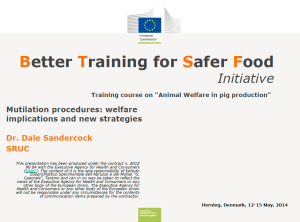
Training course animal welfare in pig production

Dr. Dale Sandercock recently took part as a tutor along with Dr. Mette Herskin and Dr. Lene Juul Pedersen in an EU – Better Training for Safer Food (BTSF) training course on Animal Welfare in Pig Production in Herning, Denmark (12-15 May, 2014). The course was aimed at Official Veterinarians belonging to the NCAs (National Competent Authorities) of EU countries involved in official controls on animal welfare concerning the farming of pigs and the development of best practices to improve the application of EU standards. Dale presented a lecture on mutilation procedures: Welfare implications and new strategies. As part of the presentation he reported on the recent setting up of the FareWellDock project and it’s aims in relation to the issues of tail docking and tail biting. Dale was approached by several of the participants for more information about the project and he directed them to this website for further information. The course was attended by 53 participants (mostly from national veterinary institutes) from 28 EU, and candidate countries.

Traning course on mutilations by Dr. Dale Sandercock
Training course on mutilations by Dr. Dale Sandercock

SRUC press release

SRUC issued a press release and posted this message on their website:
New Project Aims to End Tail Docking.
In response BBC’s Farming Today interviewed Prof. Sandra Edwards (Newcastle University, 12-09-2013).

Secondary coverage:
Connect – Sustainable Food Supply and Security. 11-09-13. New project aims to end tail docking in pigs
Farmers Weekly Interactive 11-09-13 New project aims to end pig tail docking in EU
Farm Business – Online 11-09-13 New project aims to end tail docking.
Farming Monthly 11-09-13 New project aims to end tail docking
FarmingUK 12-09-13 New project aims to end tail docking
Press and Jounal (Aberdeen), J. Watson 12-09-13 Study launched in bid to end docking of pigs’ tails.