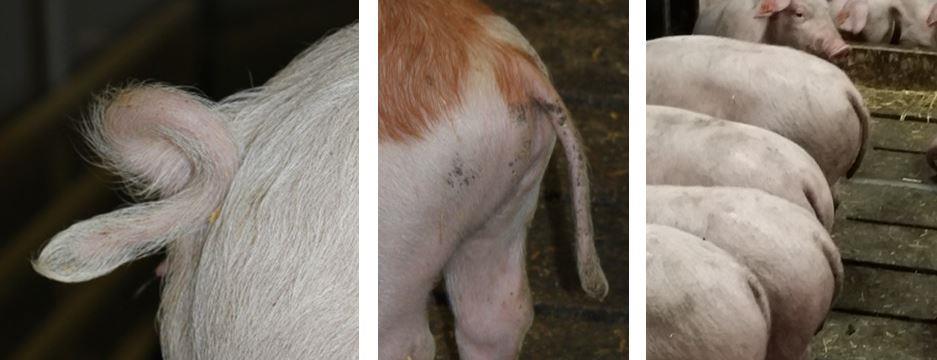
Tail biting is a well-known production disease in intensively-farmed pigs raising concern for animal welfare, e.g. related to the practice of routine tail docking. To reduce tail biting pigs are provided with enrichment materials. EU legislation requires that pigs have permanent access to a sufficient quantity of material to enable proper investigation and manipulation activities. In order to meet this directive many pigs are provided with a metal chain with or without a rather indestructible object attached to the chain. The European commission recently revised current guidelines as to what constitutes adequate enrichment, apparently moving into the direction of the status-quo in welfare schemes. Building on extensive previous work at Wageningen UR Livestock Research, especially on the modelling of pig enrichment (the so-called RICHPIG model) a review is presented of our current state of knowledge. In addition, an outline is given as to how so-called AMI-sensors, measuring Animal-Material Interactions (AMI) (semi-)automatically, can be used to assess the pig’s need for enrichment, also in relation to aspects associated with health status, such as feed restriction, biting wounds and streptococcus infection. It is suggested that the use of chains with or without rather indestructible materials such as pipes, balls or (hard)wood is generally inadequate to enrich the pens of intensively-farmed pigs. An evolutionary mechanism appears to be underlying the causation of multifactorial welfare problems in general, the issues of enrichment, tail biting and tail docking in pigs in particular. In this respect ongoing selection for increased resource efficiency has been exerting a profound impact on livestock production. Various routes are explored as to how persistent welfare problems may be resolved, including a method that has been called Intelligent Natural Design (IND).
Two organic pigs interacting simultaneously with a branched chain in the snow. Despite access to a straw bed for rooting, even organic pigs may interact with such chains for long periods of time, esp. directed towards the floor. In fact they will root the chain on the floor more than twice as much as playing with it in a horizontal position. In intensive pig production chains are often (too) short, and when a hockey-type ball or ‘sustainable’ plastic pipe is attached to the end of such a chain the pigs’ interest, and their welfare, is often even reduced further. By contrast, to improve the chain further 7mm stainless-steel anchor chains may be recommended for growing pigs over the cheaper c-chain shown here, as anchor chains have heavier and more rounded shackles.
See also an older previous presentation on tail biting.
Welfare problems in pigs often arise from an imbalance between the challenges they are exposed to and their adaptive capacity. A major challenge for pigs is the weaning transition. Weaning often results in reduced growth, intestinal problems and damaging behaviors. The natural behavior of pigs and their adaptive strategies can inspire us to reduce weaning-related problems. We found that early ingestion of feed can be stimulated by facilitating information transfer from sow to piglet, both through flavor learning in utero and social learning. This early feeding, in turn, seems vital for a good post-weaning performance. Also enrichment substrates that stimulate early sampling of feed positively affect piglet performance around weaning. We are developing a multi-litter group housing system for lactating sows and their piglets in which both opportunities for sow-piglet information transfer and enrichment substrates are provided. Piglets raised in this system and kept in large groups post-weaning show improved performance until at least 9 weeks of age. Measures that facilitate the weaning transition in pigs typically also reduce the occurrence of damaging behaviors directed at pen mates, such as tail biting and ear biting. These behaviors both reflect and generate welfare problems, and are influenced by multiple factors. Apart from the impact of early life conditions, we studied the contribution of (genetic) characteristics of pigs and of their environment to the tendency of displaying damaging behaviors. Tail biting seems associated with fearfulness, serotonin metabolism and with (genetic and phenotypic) production characteristics. Excessive levels of damaging behaviors lead to reduced growth in the victims, and we therefore investigated the impact of a novel breeding strategy, targeting indirect genetic effects on growth. Pigs with high indirect genetic effects on growth inflicted less tail damage and showed less ear biting. They also seemed less fearful and showed lower leukocyte, lymphocyte and haptoglobin levels. Enrichment with straw bedding had similar beneficial effects additive to those of the new genetic strategy. On most farms it is, however, not feasible to provide pigs with straw, and we therefore studied the effectiveness of a simple enrichment material – a burlap sack – and found a twofold reduction in damaging behaviours and a five-fold reduction in the proportion of animals with a tail wound. In conclusion, – small and large – changes in genetic background, early life conditions and quality of the environment that contribute to the adaptive capacity of pigs, and reduce their stress load, can be used to improve pig welfare and performance in concert.
This study examined effects of the amount of straw offered on occurrence and severity of gastric lesions in pigs kept in pens (18 pigs, 0.7m(2)/pig) with partly slatted flooring and 10, 500 or 1000g straw/pig/day from 30kg live weight. The pigs had ad libitum access to dry feed. Forty-five pigs were used, three from each of 15 pens. After euthanisia, the dimension of the non-glandular region of the stomach was measured. Lesions were characterized and scored. Irrespective of straw provided, 67% of the pigs showed signs of gastric pathology. Pigs provided with 500 or 1000g straw were pooled as ‘permanent access’. The proportion of pigs with ulcerations was reduced by permanent access to straw (7 vs. 33%; P<0.05), suggesting that permanent access to straw may improve animal health, and be considered as one possible strategy to limit gastric ulceration in pigs.
It applies to all categories of pig and lays down minimum standards for their protection:
Providing permanent access to …. materials for rooting and playing
COMMISSION RECOMMENDATION (EU) 2016/336 of 8 March 2016 on the application of Council Directive 2008/120/EC laying down minimum standards for the protection of pigs as regards measures to reduce the need for tail-docking.
STAFF WORKING DOCUMENT(706 kB) on best practices with a view to the prevention of routine tail-docking and the provision of enrichment materials to pigs [SWD(2016)49 final] Following the adoption of the Commission Recommendation (EU) 2016/336 as regards measures to reduce the need for tail-docking, the staff working document provides useful tools to a harmonised understanding on how the provision of manipulable material and avoidance of tail-docking can be practically achieved.
The working document recognises that proper enrichment is important to help prevent tail biting, and hence the need for tail docking.
Specified as unsafe are synthetic ropes, tyres, dry wood, dry sawdust, poorly stored straw, untreated peat/mushroom compost and dirty objects.
Furthermore proper enrichment should have one or more of the following qualities:
Edible or feed-like (to eat or smell)
Chewable (to bite)
Investigable (to root)
Manipulable (to change its location, appearance or
structure)
Provision should be
of sustainable interest
accessible
of sufficient quantity
clean
MATERIALS OF MARGINAL INTEREST
Materials of marginal interest should not be used as essential or single component of pig
enrichment materials. They can provide distraction but should not be considered as
fulfiling the essential needs of the pigs. Other materials should also be provided.
Materials of marginal interest include objects, such as hard plastic piping or chains.
Marginal materials may supplement suboptimal materials like stones or strawdust briquette.
Tail biting, resulting in outbreaks of tail damage in pigs, is a multifactorial welfare and economic problem which is usually partly prevented through tail docking. According to European Union legislation, tail docking is not allowed on a routine basis; thus there is a need for alternative preventive methods. One strategy is the surveillance of the pigs’ behaviour for known preceding indicators of tail damage, which makes it possible to predict a tail damage outbreak and prevent it in proper time. This review discusses the existing literature on behavioural changes observed prior to a tail damage outbreak. Behaviours found to change prior to an outbreak include increased activity level, increased performance of enrichment object manipulation, and a changed proportion of tail posture with more tails between the legs. Monitoring these types of behaviours is also discussed for the purpose of developing an automatic warning system for tail damage outbreaks, with activity level showing promising results for being monitored automatically. Encouraging results have been found so far for the development of an automatic warning system; however, there is a need for further investigation and development, starting with the description of the temporal development of the predictive behaviour in relation to tail damage outbreaks.
This first week of February 2016 two items related to tail biting appeared in farmers’ press in The Netherlands. In addition, we recently provided input into a European project on the welfare of poultry, which will be reported on briefly below.
One news item announced that farmers are invited at the Intensive Farming Fair in Venray (LIV Venray), March 1-3 2016. At the fair two finished tail-biting projects will be presented and discussed with entrepreneurs who are active in intensive farming. One of the projects is ‘Keeping pigs with intact tails’.
The other item was a report on the German tail biting (Ringelschwanz-)project. First results of the curly-tail project in North-Rhine Westphalia showed that more than one quarter of piglets at 15 participating research farms had damaged tails before the end of the rearing period. At some farms half of the tails had been bitten. At the 15 farms participating in the study 30-94 piglets had been reared on each farm without tail docking. Outbreaks of tail biting appeared to be associated with streptococcus infections. Prevention and intervention strategies included providing dried maize silage or alfalfa hay twice daily and the isolation of biters respectively. Most tail biting occurred between week 2 and 4 after weaning. This level of tail biting is not so good news. If these levels of tail biting would persist, it may indicate that intensive systems cannot be made compatible with acceptable levels of animal welfare. Fortunately, however, experiences in Finland indicate that it should be possible to keep undocked pigs in conventional systems at much lower levels of tail biting (around 2% based on slaughter house data).
The German farmers union and North-Rhine Westphalia have agreed 1.5 years ago that they intend to stop tail docking by 2017. This will be done provided on-farm research shows that tail biting among pigs with intact tails does not reduce animal welfare. The general expectation is that the objective of safely quitting tail docking cannot be met.
From a Dutch research perspective two notes appear to be relevant:
The first is that our semantic-modelling approach provides a unique methodology to determine/assess the cut-off point between the welfare impacts of tail biting and tail docking using formalised biological reasoning and scientific evidence. In this computation one must take into account all relevant aspects: So, not only the point that the welfare of tail bitten pigs is reduced due to blunt trauma (biting) compared to the sharp trauma of tail docking at an earlier age. But also the point must be recognised that the welfare of tail biting pigs may relatively be improved when they can bite their penmates’ tails, compared to when they cannot (other things being equal, i.e. lack of suitable enrichment). What matters for welfare as considered from the animals’ point of view is the extent to which they can satisfy their needs, e.g. for biting and the expression of species-specific foraging behaviour, taking into account also the activation of coping mechanisms such as redirected and harmful-social behaviours.
The second thing to note about the results of the German research project is the following. In addition to taking note of the bad news (many bitten tails, which has to be taken seriously, perhaps even to the point that the conclusion must be drawn that intensive systems are not compatible with acceptable animal welfare), one may also try to move forwards for the time being by focussing on the good news: Two out of the 15 pilot farms in Germany managed to keep all piglets’ tails intact. Other farms may learn from what was done on these farms to keep tails intact. Furthermore, since the EC Directive requires that all farms try to periodically keep at least some intact pigs, a 10% success rate could provide sufficient scope for progress at the population level, even when the causes of the success are poorly understood. This can be concluded from a methodology we designed previously to solve complex welfare problems like feather pecking in poultry and tail biting in pigs. This methodology has been called ‘Intelligent Natural Design’ (INO in Dutch; see also Bracke, 2010). It basically uses evolution to select the best farms to make increasing progress towards the objective of completely stopping the practice of routine tail docking in pig farming.
Countering the routine practices of tail docking and beak trimming, as well as preventing and treating outbreaks of tail biting and feather pecking requires an understanding of tipping points. Recently, we modified our tipping-bucket model for tail biting for inclusion on the Henhub website. This website, which is part of the Hennovation project, gives information about welfare issues in poultry, esp. (at present) feather pecking. On that site the modified tipping-bucket model can be found under the post describing the mechanism of feather pecking.
Tipping-bucket model of tail biting in pigs
.
Bracke, M.B.M. 2010. Towards long(er) pig tails: New strategy to solve animal welfare problems. In: Lidfors, L., Blokhuis, H., Keeling, L., Proceedings of the 44th Congress of the ISAE, August 4-7 2010, Wageningen Academic Publishers, Wageningen, p. 135. (Poster, ISAE 2010, Uppsala, Sweden, Aug 4-7.
A 4-year project of “Strategies to reduce the risk of tail biting in pigs managed on slatted floors” has started. It is a collaboration between Teagasc, SRUC and the University of Edinburgh.
Below is a poster on the project presented in the Teagasc Pig Farmers’ Conference 2015.
The project will aim to explore ways to reduce tail-biting on slatted floor systems where straw is not available by environmental enrichment and nutritional strategies.
The enrichments used at the moment are compressed straw and different wood types.
Later the project will also investigate the effects of various lengths of tails, measures to predict tail-biting outbreaks and methods to interfere effectively.
The project will be supervised by Dr Keelin O’Driscoll (Teagasc), Dr Rick D’Eath (SRUC), Dr Dale Sandercock (SRUC), and Prof Natalie Waran (University of Edinburgh).
Dr Amy Haigh is the postdoctoral researcher working together on this project in Teagasc, and Dr Laura Boyle and Dr Edgar Garcia Manzanilla are also the collaborating researchers in Teagasc. I (Jen-Yun) am the PhD student on this project.
We investigated the effect of straw amount on pigs’ time spent manipulating straw.
We investigated the effect of straw amount on pigs’ simultaneous straw manipulation.
Increasing straw from 10 to 430 g/pig/day increased both measures.
Increasing straw above approx. 250 g did not significantly increase the behaviour further.
Abstract
According to European legislation, pigs must have permanent access to sufficient quantity of material to enable manipulation activities. However, few studies have quantified how much straw is needed to fulfil the requirements of growing pigs. We investigated the effect of increasing amount of straw on pigs’ manipulation of the straw, and hypothesised that after a certain point increasing straw amount will no longer increase oral manipulation further. From 30 to 80 kg live weight, pigs were housed in 90 groups of 18 pigs in pens (5.48 m × 2.48 m) with partly slatted concrete floor and daily provided with fresh uncut straw onto the solid part of the floor. Experimental treatments were 10, 80, 150, 220, 290, 360, 430 or 500 g straw per pig and day. At 40 and 80 kg live weight, the time spent in oral manipulation of the straw by three focal pigs per pen (large, medium and small sized) were recorded along with the percentage of pigs manipulating straw simultaneously. This was recorded in three 1-h intervals (1 h before and 1 h after straw allocation in the morning, as well as from 17 to 18 h in the afternoon). With increasing quantity of straw provided, we found a curvilinear (P < 0.01) increase in the time spent in oral manipulation of the straw. Smaller pigs spent more time manipulating straw than larger and medium sized pigs (367, 274 and 252 s/h for small, medium and large sized pigs, respectively; P < 0.001), and pigs spent more time manipulating straw at 40 kg than 80 kg live weight (356 vs. 250 s/h; P < 0.001). At both live weights, pigs spent most time manipulating straw during the hour after allocation of straw. Similar effects of increasing amounts of straw were found for the percentage of pigs engaged in simultaneous manipulation of the straw. Post hoc analyses were applied to estimate the point, after which additional straw did not increase manipulation of straw any further. For the time spent manipulating straw the estimated change point was 253 (approx. 95% confidence limits (CL) 148–358) g straw per pig and day. For the number of pigs simultaneously manipulating straw the change point was 248 (CL 191–304) g straw per pig and day. These results show that increasing the quantity of straw from minimal to approximately 250 g per pig and day increased the time spent in oral manipulation of the straw, as well as the occurrence of simultaneous straw manipulation.
Hence, data from the current experiment identified 250 g straw per pig per day as the amount of straw where a further increase in straw provision did not further increase neither time spent on oral manipulation of straw, nor the percentage of pigs simultaneously manipulating straw. This suggests that, within the current housing system and using this criterion, this amount of straw may be the biological turning point for increasing oral manipulation of straw.
The German Federal Research Institute for Animal Health (FLI) has reviewed current research on tail biting in pigs.
The report entitled “Übersicht über Untersuchungen zum Themenkomplex „Schwanzbeißen” makes specific recommendations as to how to best tackle the tail biting problem. The report also has an extensive appendix (under ‘documents’) listing projects, main project results and references on tail biting.
Twenty-six different research projects were counted in Germany alone. Many other projects were also listed in other EU countries (The Netherlands, Belgium, UK, Ireland, Denmark, Finland, Sweden, Norway, Spain and Hungary). Also the EFSA and FareWellDock activities were noted, as well as the International Pig Welfare Conference in Denmark in April 2015 (see our Soundbite posts 1, 2, 3, 4 and 5).
The report has a detailed list of recommendations split for the farm and regional level. At farm level risk assessment, gradual reduction of tail docking, networking, demonstration farms, and trying-out of practical solutions to prevent and treat tail biting are mentioned. At the regional and national level the report mentions the collection and distribution of knowledge in various ways, the coordination of activities, the building of networks of tail biting experts, education/training, the installation of an information platform and the support of research projects using standardised protocol and cooperation with other EU countries.
The report noted a trend for tail biting to start at rather earlier ages (shortly after weaning, but also even before weaning, as has previously been observed by Dr. Ursinus).
It was also noted that on average 70% of the pigs used in the 26 research and field projects in Germany had severe tail lesions. Since these projects were focussing on (improvements of) current housing conditions, it may be questioned whether and to what extent current systems are suited to finally succeed in stopping completely the current practice of tail docking.
During the two-day conference, top academics, experts and political stakeholders from around the world debated and worked to prepare the way forward in improving pig welfare in Europe and ultimately in the world. Ministers from the Netherlands, Germany and Sweden participated.
Below you find ‘soundbites’ from the conference, all more or less related to the subjects of study in the FareWellDock project. This is part 1. Parts 2-5 are other blog posts on this website.
It is truly remarkable that we have been able to gather almost four hundred participants to discuss the ways forward for pig welfare; some are joining us from as far away as the state of Iowa, USA, and Australia Dan Jørgensen, Danish Minister for Food, Agriculture and Fisheries
Left to right: Dan Jørgensen, Minister for Food, Agriculture and Fisheries, DK. Sharon Dijksma, Minister for Agriculture, NL. Sven-Erik Bucht, Minister for Rural Affairs, SE. Christian Schmidt, Federal Minister of Food and Agriculture, DE.
At the conference a position paper was signed by
Christian Schmidt, Federal Minister of Food and Agriculture, DE
Sven-Erik Bucht, Minister for Rural Affairs, SE
Dan Jørgensen, Minister for Food, Agriculture and Fisheries, DK
Sharon Dijksma, Minister for Agriculture, NL