Category Archives: Tail docking

Routine tail docking of pigs

This post presents the abstract and executive summary of the EU report:

Marzocchi, O. 2014.  Routine tail-docking of pigs. Policy Department C: Citizens’ Rights and Constitutional Affairs, European Parliament, European Union, Brussels, accessed 17-2-2015.

Abstract

Upon request of the PETI committee, the present study examines the issues raised in Petition 0336/2012, the legal framework on the protection of pigs, the level of implementation of the Directive on the protection of pigs in relation to tail-docking on the basis of the available information, the actions being carried out, or that could be carried out, to ensure proper implementation by Member States of the Directive requirements.
Docking a piglet's tail using cautery (hot iron)

Executive summary

The Committee on Petitions (PETI) examined on the 1st of April 2014 Petition 0336/2012 by C.R. (Danish citizen), on behalf of Dyrenes Beskyttelse (Danish Animal Welfare Society), concerning the routine tail-docking of piglets in Denmark1.

The petition raised the issue of the lack of implementation in Denmark, as well as in most EU Member States, of Council Directive 2008/120/EC laying down minimum standards for the protection of pigs, in relation to the rules governing the tail-docking of pigs.

The Commission recognised during the discussion that the implementation of the Directive in this regard is not satisfactory, but stated that it did not intend to launch infringement proceedings nor to propose amendments to the Directive, considering these actions as not appropriate. It stated instead that it preferred to rely on guidelines for Member States to ensure better implementation of the Directive, as well as on e-learning tools that are currently being developed. It also pointed to upcoming initiatives, such as framework legislation on animal welfare.

On the same day, PETI committee coordinators discussed the petition, the unsatisfactory implementation of the Directive, as well as the refusal by the Commission to launch infringement proceedings against non-compliant Member States. It was decided to request the Policy Department to analyse the issues discussed so to allow the committee to re-examine the matter during the new parliamentary term, including by potentially deciding to send a delegation to a number of Member States to investigate on the effective implementation of the Council Directive.

The present study addresses the PETI coordinators’ request to analyse the issues raised in the petition, the legal framework on the protection of pigs, the level of implementation of the Directive on the protection of pigs in relation to tail-docking on the basis of the available information, and the actions being carried out, or that could be carried out, to ensure proper implementation by Member States of the Directive requirements.

The study concludes that:

all the available evidence points at persisting high rates of non-compliance in the large majority of Member States in relation to the ban on routine tail-docking of pigs;

-Commission guidelines, training and e-learning tools, including on enrichment and manipulable materials, as well as a possible Framework Law on Animal Welfare, can be useful instruments to support farmers and Member States’ authorities in the implementation of the Directive; – at the same time, these could be accompanied by a stricter enforcement policy, notably since the Directive has been in force for more than 10 years (while the ban on routine tail-docking has been in force for more than 20 years); – the Commission could be bolder and prepared to launch infringement proceedings as an enforcement tool of last resort, as the mere prospect of serious action may prompt Member States to comply; – the Commission could also more systematically collect, monitor and publish information on the transposition of the Directive by Member States, as well as on their degree of compliance with the ban on routine tail-docking of pigs, including through inspections and specific requests to Member States.

Box 1: Tail-biting, tail-docking, routine tail-docking, enriching and manipulable material

Tail-biting, ie a pig biting another pigs’ tail, is an abnormal behaviour caused by several risk factors, notably by a poor or stressful environment frustrating the normal investigative behaviour of pigs (which are among the most intelligent and curious animals) in common intensive farming conditions. Tail-biting can result in infections, affecting the health and well-being of tail bitten pigs and can lead to tail-biting outbreaks.

Tail-docking is the practice of removing the tail or part of the tail of a pig, while routine tail-docking is the systematic docking of the tail of pigs, normally done in the early days of life, with the aim of avoiding the risk of tail-biting. It is done without anaesthesia, though it is a mutilation which is painful. Tail-docking can cause long-term chronic pain and infections, as well as redirection of the biting behaviour to other body parts, such as ears and legs.

Enriching and manipulable materials are materials such as straw, hay, wood, sawdust, mushroom compost and peat or a mixture of these, with which pigs can satisfy their explorative, playful and foraging behaviours. Studies have highlighted that the provision of such materials has a positive effect on pigs, reducing the risk of tailbiting.

Note: The opinions expressed in this document are the sole responsibility of the author and do not necessarily represent the official position of the European Parliament
Training course animal welfare in pig production

Dr. Dale Sandercock recently took part as a tutor along with Dr. Mette Herskin and Dr. Lene Juul Pedersen in an EU – Better Training for Safer Food (BTSF) training course on Animal Welfare in Pig Production in Herning, Denmark (12-15 May, 2014). The course was aimed at Official Veterinarians belonging to the NCAs (National Competent Authorities) of EU countries involved in official controls on animal welfare concerning the farming of pigs and the development of best practices to improve the application of EU standards. Dale presented a lecture on mutilation procedures: Welfare implications and new strategies. As part of the presentation he reported on the recent setting up of the FareWellDock project and it’s aims in relation to the issues of tail docking and tail biting. Dale was approached by several of the participants for more information about the project and he directed them to this website for further information. The course was attended by 53 participants (mostly from national veterinary institutes) from 28 EU, and candidate countries.

Traning course on mutilations by Dr. Dale Sandercock
Training course on mutilations by Dr. Dale Sandercock

Throughput capacity of straw on slatted floors

Providing straw is a well-known obstacle for use on slatted floors because as the straw may rapidly get out of reach of the pigs by falling through the slats and because the straw may block the liquid manure handling system. Research in Sweden investigates the throughput capacity of straw for nestbuilding in farrowing sows and for reducing tail biting in weaned and growing-fattening pigs.

Nest-building behaviour is regarded as a behavioural need for the pre-partum sow and sows in modern pig husbandry are highly motivated to perform this behaviour. A sow that lacks possibilities to perform foraging and nest-building behaviour at farrowing will be frustrated and stressed, which can result in reduced piglet survival or savaging of piglets. Thus, sows should be provided with appropriate substrate to perform nest-building behaviour at farrowing.
Furthermore, many newborn piglets in modern pig production develop lameness and poor claw health due to poor floor quality. Lame piglets often need medical treatment and have a reduced growth rate. The claws of newborn piglets have an extremely soft horn tissue making them vulnerable to bruising in early life. However, a few days after birth, the horn tissue becomes harder and more resistant to injury. Provision of straw as bedding only during the first week of life might therefore be sufficient to reduce the incidence of lesions. Straw bedding is also a source of thermal insulation, found to be suitable for the prevention of prolonged hypothermia in newborn pigs. Piglets with a low body temperature are more likely to die from infections or crushing. Provision of straw to newborn piglets may increase their welfare by decreasing the risk of lameness and/or hypothermia.
In a Swedish study a strategic usage of straw was investigate in two commercial piglet producing farms. The ability of straw to drain through slatted flooring was studied giving the sows 15 kg of chopped straw around the time of farrowing. In total 96 sows were studied and all sows were loose housed in partly slatted farrowing pens (plastic or cast-iron slats). Chopped wheat straw of three different lengths was compared. The mass median straw lengths were 39, 70 and 130 mm, respectively. It was found that by Day 4 after farrowing straw with short and medium chop length was completely absent in 83% (plastic slats) and 85% (cast-iron slats) of the pens. However, at Day 4 straw was absent in only 6-7% of the pens provided with the longest straw category.
The conclusion from the study is that it is technically feasible to maintain good pen hygiene in partly slatted farrowing pens, even if the sows are provided with 15 kg of chopped straw at farrowing. However, straw chop lengths need to be adjusted to the type of slatted flooring used.

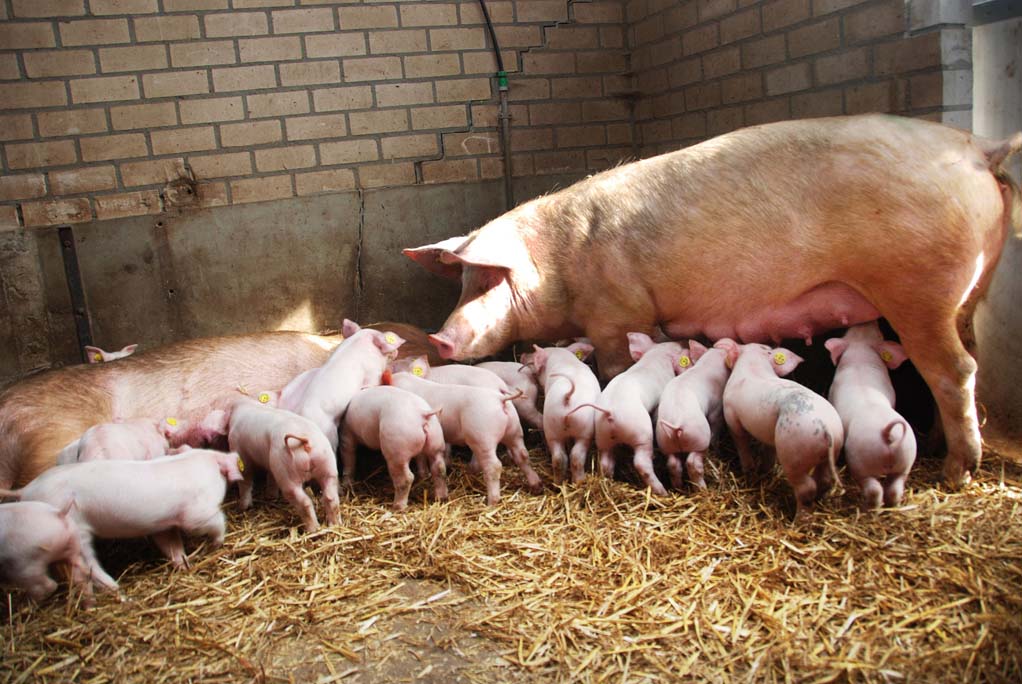
Farrowing sow in straw nest (Photo by Rebecka Westin)

When these results are applied to the objective of using straw as enrichment for growing pigs and to counteract tail biting, the paper shows that it is possible to use straw cleverly and adapt the straw structure to the slatted floor. Optimal is that we give the pigs straw of a structure that enhances their litter related behaviours, but at the same time remains manageable for the farmer and the manure system. This study shows that chopped wheat straw of mass median lengths between 39 and 70 mm can be managed in a slatted system. The paper also evokes the thought that the amount of straw could be varied according to the behavioral needs of the growing pigs, e.g. more straw could be provided to the pigs when they are put into to a new compartment after weaning. Ideally, it could also be possible to develop a monitoring system of early warning of impending tail-biting outbreaks and then increase the amount of straw given to the pigs to counteract (and hence prevent) the outbreak. This could be partly automatic (precision livestock farming).

Farrowing sow and piglets on straw (Photo of Rebecka Westin)

Some further questions
* To what extent was the straw remaining available to the pigs, e.g. what % is lost through the slats and for how long is it visible in the pen?
The straw (15 kg) was given 2 days prior to expected farrowing and the remains were scored 6 days later (i.e. four days after farrowing). Plastic slats dimensions were: slat width 15 mm, opening width 10 mm, opening length 36 and 84 mm. Cast iron slats: slat width 11mm, opening width 11 mm and opening length 200 mm.
In plastic-slatted pens (i.e. on Farm A), bedding was completely absent (0 kg) on Day 4 in 25 of 30 pens (83%) when provided with straw of short or medium chop lengths compared to 1 of 15 pens (7%) provided with long straw. Similar figures were seen on Farm B which had cast-iron slatted pens, where bedding was absent in 22 of 26 short/medium straw pens (85%) and 1 of 17 long straw pens (6%), respectively. On Day 4 after farrowing, 37 of 43 cast-iron pens (86%) were completely dry and clean on the solid floor. This was the same for the plastic-slatted pens provided with bedding of short or medium straw. However, in plastic-slatted pens provided with bedding of long straw, hygiene became worse over time.

* To what extent did the manure system get blocked, both in the short term and long term?
It was never blocked as the sow and the piglets were degrading the straw over time. In this case 15 kg was given once to the sows for the 6 days. After that, from Day 4 after farrowing and onwards, a small amount of chopped straw (~0.5 kg) was given daily according to the farms’ regular management practice. Weaning was performed after 5 weeks. For the total suckling period it was ~35 kg of straw used.

* What remains to be done in the FareWellDock project?
We will investigate the straw amount and the length that could be used to find an optimum level for usage in semi-slatted pens for growing-fattening pigs. The optimum is where enough straw is provided to minimise the risk of tail and ear biting, while pen hygiene and manure system continue to function at acceptable levels to the farmer. We will start with a survey in Sweden to investigate this further.

Background paper: R. Westin , N. Holmgren , B. Mattsson and B. Algers, 2013. Throughput capacity of large quantities of chopped straw in partly slatted farrowing pens for loose housed sows, Acta Agriculturae Scandinavica, Section A – Animal Science

Sow and piglets on straw

See also:
Westin, R., Holmgren, N., Hultgren, J. and B. Algers, 2014. Large quantities of straw at farrowing prevents bruising and increases weight gain in piglets. Preventive Veterinary Medicine 115: 181-190. doi: http://dx.doi.org/10.1016/j.prevetmed.2014.04.004.
Westin, R. 2014. Strategic Use of Straw at Farrowing – Effects on Behaviour, Health and Production in Sows and Piglets. PhD thesis, SLU, Skara.

Highlights
•Strategic use of large quantities of straw effectively prevents piglets from developing skin abrasions and claw lesions.
•The overall prevalence of skin and claw lesions was reduced by at least 50% in STRAW compared to CONTROL piglets.
•Average daily weight gain until 5 days of age increased by 25 g in the STRAW treatment.
•Mean body weight at weaning increased by 0.33 kg

Reducing tail docking in the Netherlands

On April 4, 2014 the Dutch Secretary State of Economic Affairs, Sharon Dijksma, reported to the Dutch parliament the following on the issues of tail docking and tail biting in pigs:
Firstly, research has been commissioned on tail biting and tail docking in pigs (2013-2017).
Secondly, steps have been taken to reduce tail docking in practice (Van Dekken, 28286, nr. 666).
The House of Parliament has asked the government to negotiate an end date for tail docking together with the stakeholders who signed the Declaration Dalfsen.
Since early 2013 the European Commission is working on a plan to address routine docking of piglets at the European level. In parallel, the Dutch pig sector organisations LTO and NVV, and the Dutch Society for the Protection of Animal together drafted and signed the Declaration of Dalfsen, which was presented on June 10, 2013. The Declaration focuses on the prevention of biting , the gradual reduction of short tail docking, leading finally to the responsible ending of the practice of tail docking . It is a process in which partners have expressed trust in each other. These are important steps in the right direction. The Animal Welfare policy note states that the declaration is endorsed and supported by the funding of research. In about two years this research is likely to provide insight if and which promising solutions exist. At that point in time more will be known about the progress made at the European level. At that time the Secretary of State and the partners of the declaration will determine a realistic deadline to responsibly stop the tail docking of pigs.
Finally, as to the strict compliance of the EC Directive on pig welfare in Europe (Ouwehand, TK 21501-32, nr. 750): The House of Parliament has asked the government insist that the European Commission will move towards strict enforcement of animal welfare guidelines and reports on compliance in the Member States. This is related to signs of non-compliance of the Directive by several Member States and more specifically in the areas of tail docking and the routing filing of canine teeth.
With a view to improving the implementation and enforcement of the Directive lying down minimum standards for the protection of pigs (2008/120/EC), the Commission – partly based on the Dutch request – started the development of guidelines supplementing the Directive, including a guideline on tail docking. These guidelines (which are expected to be completed this year) are expected to improve enforcement and compliance.

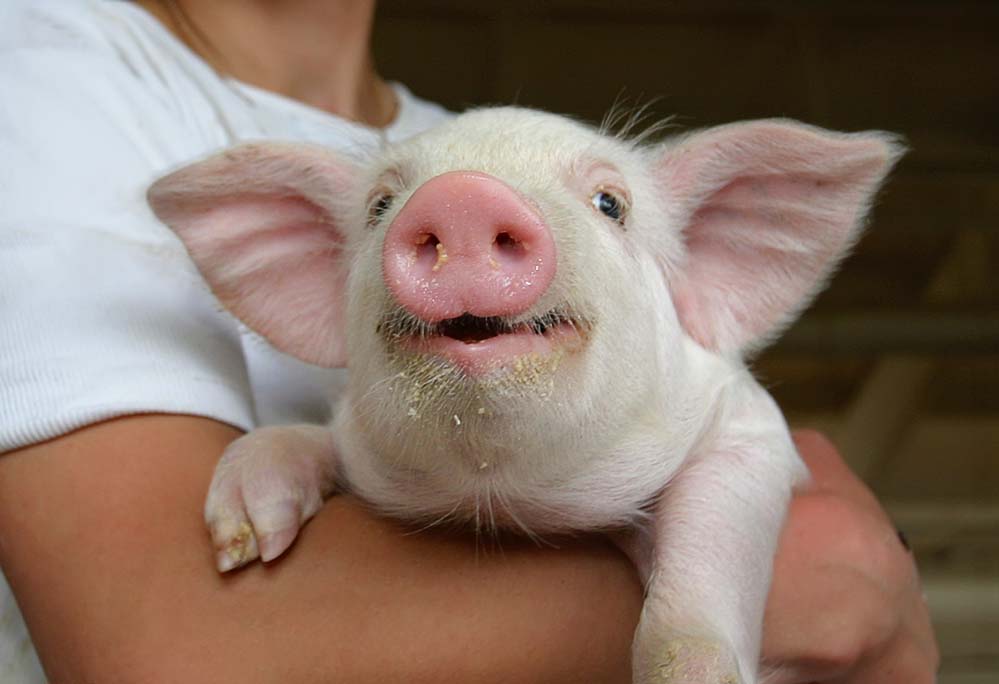
Pig on arm
Piglet on arm

Scientists start new EU project to reduce tail biting and docking in pigs

Scientists from eight countries are starting a research project on how to prevent one of the major behavioural problems on commercial pig farms: tail biting. The aim of the collaboration is to yield new knowledge which will help to remove the need for tail docking, the currently widespread preventive practice of cutting off part of the tails of young piglets..
Why do pigs’ tails get damaged?
Tail biting is one of the major problems in modern pig production, both in terms of animal welfare and production economy. It is an abnormal behaviour that can result from several causes, such as stress, illnesses, a poor indoor air quality or competition for food or water. One of the main causes is lack of materials that the pigs can chew on or root. Pigs have a strong innate need for exploring their environment by chewing, biting, rooting and manipulating various objects and materials. When there are not enough exploration and manipulation substrate in a pen, the biting can get redirected to other pigs, especially ears and tails, which may result in tail biting.

In many European countries, tail docking – the practice of cutting part of the piglets’ tails at a young age – is used to control the problem. While this does reduce the risk of being bitten, it causes pain during cutting. Is also possible that, for the rest of their lives, damage to the tail nerves caused by docking may alter the sensitivity of the tail to touch. Some farmers, consumers, legislators etc. would like to stop the practice of tail docking. The EU pig directive states that tail docking can only be used if other means of preventing the behaviour have been tried. In some countries, for example Sweden, Norway and Finland, the practice of tail docking already is banned., These countries therefore provide an opportunity for testing other methods to prevent tail biting without the need to dock.

Searching for new knowledge on causes and prevention

The FareWellDock project is a three-year research project starting this autumn in eight countries: the UK, France, the Netherlands, Denmark, Sweden, Norway, Finland and the USA. The overall aim is to supply necessary information for quantitative risk assessment of tail biting, and to stimulate the development towards a non-docking situation in the EU.

The start-up meeting of the project took place on November 5 and 6 in Finland, after which the research will be carried out in three complementary international researcher activities. One group will delve into developing improved measures to prevent tail biting. An essential part is research into reasons for tail-biting outbreaks: which factors in the daily life on farms actually trigger this unnatural behaviour? This is work package 3 of the project. The group in work package 2 will investigate what quantity of straw, or other chewing and rooting materials, would be sufficient to satisfy the pigs’ need to explore and therefore reduce tail biting risk, and how to improve the feasibility of using straw on farms with different manure systems. The third group of scientists (work package 1) will focus on finding out what actually happens to the piglets that are tail-docked: how much pain piglets feel during docking, whether this results in longer-term pain and how this compares to the pain which is experienced by pigs which are tail bitten should an outbreak occur.

The project is led by Professor Anna Valros of the University of Helsinki in Finland. The other research institutes participating in the project are Scotland’s Rural College and Newcastle University in the UK, INRA in France, Aarhus University in Denmark, Wageningen UR Livestock Research in the Netherlands, SLU in Sweden, the Norwegian School of Veterinary Science and USDA-ARS in USA. The project is part of the European Animal Health and Welfare ERA-net initiative (ANIHWA), which aims at increasing cooperation of national research programmes on the health and welfare of farm animals.

Contact persons per country:
Prof. Anna Valros, University of Helsinki, Finland (overall coordination & work package 3)
Dr. Lene Juul Pedersen, Aarhus University, Denmark (leader of work package 2)
Prof. Sandra Edwards, Newcastle University, UK (leader of work package 1)
Dr. Jeremy Marchant-Forde, USDA-ARS, USA
Dr. Marc Bracke, Wageningen Livestock Research, The Netherlands
Dr. Stefan Gunnarsson, SLU, Sweden
Dr. Andrew Janczak, Norway
Dr. Armelle Prunier, INRA, France

FareWellDock logo
FareWellDock logo

Project objectives

FareWellDock project: aim and objectives

FareWellDock is a three-year research project which is part of the Animal Health and Welfare (ANIHWA) ERA-net initiative. The ANIHWA ERA-Net aims to increase cooperation and coordination of national research programmes on the health and welfare of farm animals.

The general aim of the FareWellDock project is to supply necessary information for quantitative risk assessment and stimulate the development towards a non-docking policy in the EU.

The project is led by Professor Anna Valros at the University of Helsinki. The other partners in the project include Scotland’s Rural College (SRUC), Newcastle University, INRA (France), Aarhus University (Denmark), Wageningen UR Livestock Research (Netherlands), SLU (Sweden) and the Norwegian School of Veterinary Science.

The research concerns the hazards related to using tail docking as a preventive measure in comparison with the hazard of being tail bitten, as well as on solving some of the main risk factors of tail biting: lack of enrichment, health problems, and delayed detection of an outbreak. In particular new animal-based measures are studied for a better comprehension of the consequences and the prevention of tail docking and tail biting, for enrichment value assessment, and for pain and sickness diagnostics. In addition to aiding future risk assessment, this project provides information about how end users (esp. farmers) can reduce tail biting.

The project has 3 work packages (WP). WP1 concerns pain related to docking and tail biting; WP2 concerns enrichment, and WP 3 concerns health and behaviour-related predispositions to tail biting. The WPs are coordinated by Newcastle University, Aarhus University and the University of Helsinki respectively.

The objectives of WP1 are:
* To characterise the time course of traumatic neuroma development caused by tail resection.
* To assess the short (acute trauma), medium (post trauma inflammation) and long term (traumatic neuroma formation) pain associated with tail docking in neonatal piglets, and the possible consequences for longer term fear of humans. At a more fundamental level, this provides a model of the effects of nerve damage (amputation) in neonates, subsequent neuroma development and its effects upon nociceptive processing throughout life.
* To assess the effects of tail-damage in more mature pigs on neuroma formation and stump pain sensitivity. This will provide a basis for assessing the pain associated with being tail

The objectives of WP2 are:
* To develop and validate a protocol for an animal-based screening method, based on exploratory behaviour and skin/tail lesions, for what constitutes a sufficient quantity of rooting material.
* To explore the feasibility and validity of using AMI sensors and tear staining to measure the value of enrichment materials under farm conditions.
* To test the effect of straw length, slat width and manure handling methods on pen functioning and ease of manure handling, and to describe suitable methods for implementing use of straw under commercial farming conditions.
* To make scientific information on methods to reduce tail docking and improve enrichment better accessible to farmers, policy makers and the general public through the establishment of a web tool and publications in farmer magazines.
* To investigate, under farm conditions, the efficiency of tail docking vs. enrichment given in sufficient quantity to reduce the occurrence of tail lesions.

The objectives of WP3 are:
* To clarify the role of poor health in the causation of tail biting and victimization. Information will be gathered on behavioural signs of sickness in pigs, and on its effects on group dynamics
* To increase knowledge about the sickness behavior of pigs suffering from different physical injuries and infectious conditions, occurring also in tail biting outbreaks. This in turn can be used when management and facilities for sick pigs are planned in the future, to decrease the adverse effects of such outbreaks
* To study the underlying central and peripheral stress- and immune-related mechanisms in detail to give insight into factors predisposing pigs to become tail biters or victims.
* To determine the characteristics of individuals for reliable identification of pigs at risk of becoming a tail biter or victim, including tail-biting related and social behaviour, and tear staining
* To develop automated systems for early warning of tail biting outbreaks which could be used especially in large herds

Project activities related to communication include the the writing of scientific papers, giving presentations at meetings/conferences, the production of webpages, blog posts and factsheets on this website, and providing input for farmer magazines.

Figure 1 of the FareWellDock project
Figure 1 Structure of the FareWellDock project

See also:
New Project Aims to End Tail Docking.
Project summary of FareWellDock on the Eranet ANIHWA website.

SRUC press release

SRUC issued a press release and posted this message on their website:
New Project Aims to End Tail Docking.
In response BBC’s Farming Today interviewed Prof. Sandra Edwards (Newcastle University, 12-09-2013).

Secondary coverage:
Connect – Sustainable Food Supply and Security. 11-09-13. New project aims to end tail docking in pigs
Farmers Weekly Interactive 11-09-13 New project aims to end pig tail docking in EU
Farm Business – Online 11-09-13 New project aims to end tail docking.
Farming Monthly 11-09-13 New project aims to end tail docking
FarmingUK 12-09-13 New project aims to end tail docking
Press and Jounal (Aberdeen), J. Watson 12-09-13 Study launched in bid to end docking of pigs’ tails.